Sold out · Ask us about restocking
Not available to order right now.
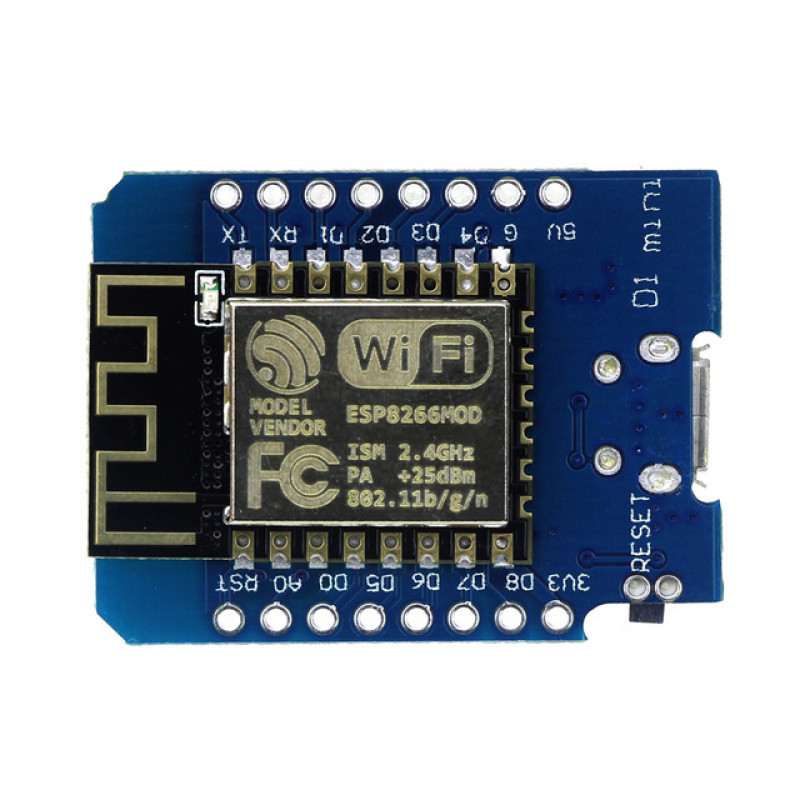
The Wemos D1 Mini is a small WiFi development board built around the ESP-8266EX chip, aimed squarely at Internet of Things projects that need wireless connectivity without much bulk. It exposes 11 digital input/output pins, all of which support interrupt, PWM and I2C or one-wire functions except for D0, plus a single analog input rated up to 3.2V.
Programming and power both go through a Micro USB connector, so getting started needs nothing beyond a standard USB cable and a computer, without a separate FTDI or CP2102 adapter.
The board uses a BRT, or Bias Resistor Transistor, circuit to make entering flash mode more reliable than some earlier ESP8266 boards, and the listing notes a 30 percent increase in radiating area compared to earlier revisions for more stable wireless performance. Physically it is small, at 35mm x 26mm x 8mm and about 10g, with a blue-coloured board.
It works with the standard Arduino IDE, with the NodeMCU firmware and Lua environment, and with MicroPython, so the choice of programming approach is largely up to the developer rather than fixed by the hardware.
Makers building small WiFi-connected sensors, home automation nodes or wearable-scale IoT projects will find the D1 Mini's size and flexible toolchain support convenient. For projects that need more GPIO or built-in peripherals, a larger ESP32-based board would offer more room to grow.
The ESP-8266EX, ST's chip does not apply here as ESP8266 is an Espressif design; it is Espressif's ESP-8266EX.
11 digital I/O pins plus one analog input rated up to 3.2V.
Arduino IDE, NodeMCU/Lua, or MicroPython.
Through a single Micro USB connector.
35mm x 26mm x 8mm, weighing about 10g.
| Brand | Generic |
|---|---|
| Chipset | ESP8266 |
| MCU / Processor | ESP-8266EX |
| Weight | 10.000000 g |
| Selling unit | PCS |