Standard checkout available. Verified maker dispatch.
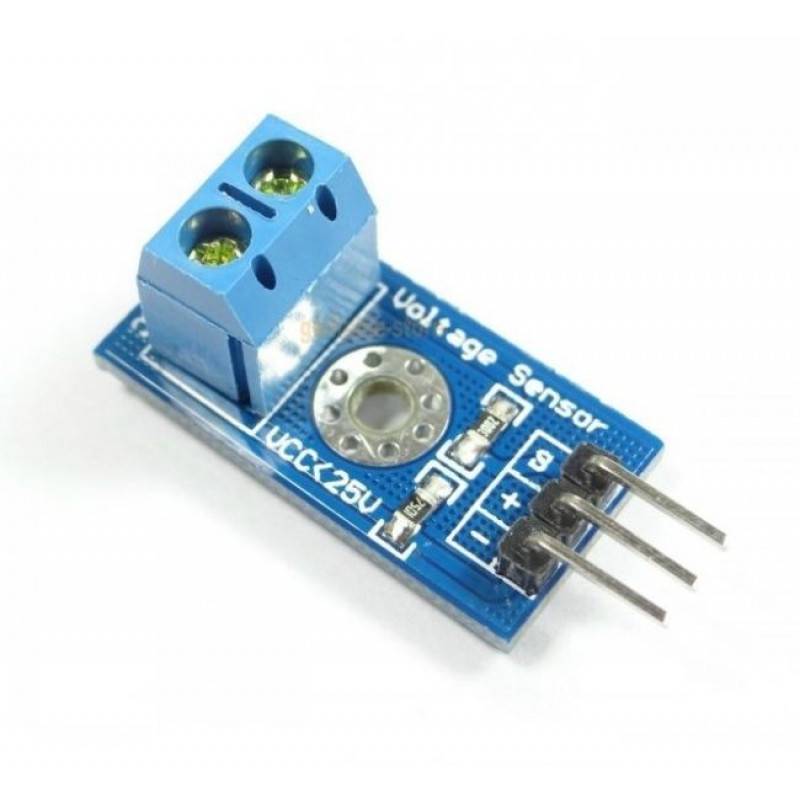
Reading a voltage higher than a microcontroller's own logic level directly through an analog input risks damaging the ADC - this voltage detection module solves that safely with a simple resistive voltage divider, scaling an input voltage down to a safe fraction before it ever reaches a connected microcontroller's analog pin, letting voltages well above the microcontroller's own supply rail be measured without risk.
Input range covers 0 to 25V DC, divided down at a fixed 1:5 ratio, meaning a 25V input arrives at the microcontroller's ADC pin as a safe 5V signal. Maximum safe input differs slightly by target system: up to 25V for 5V-logic systems (like classic Arduino) and up to 16.5V for 3.3V-logic systems (like ESP32 or STM32), since the scaled-down voltage still needs to stay within that specific board's safe ADC input range. Resolution works out to about 0.00489V per step when read through a standard 10-bit Arduino AVR ADC, giving reasonably fine voltage resolution across the measurable range.
Wiring is straightforward: a screw terminal accepts the voltage to be measured (observing correct polarity), while three output pins connect to the microcontroller - power, ground, and a signal pin wired to an analog input. No active components or calibration are needed beyond the fixed resistive divider ratio, keeping the module simple and reliable.
Builders working on a battery voltage monitor, a power-rail health check for a larger project, or any application needing to safely read a DC voltage above the microcontroller's own supply level will find this voltage detection module a straightforward, inexpensive way to do that measurement without risking ADC damage.
| Brand | Generic |
|---|---|
| Selling unit | PCS |