Standard checkout available. Verified maker dispatch.
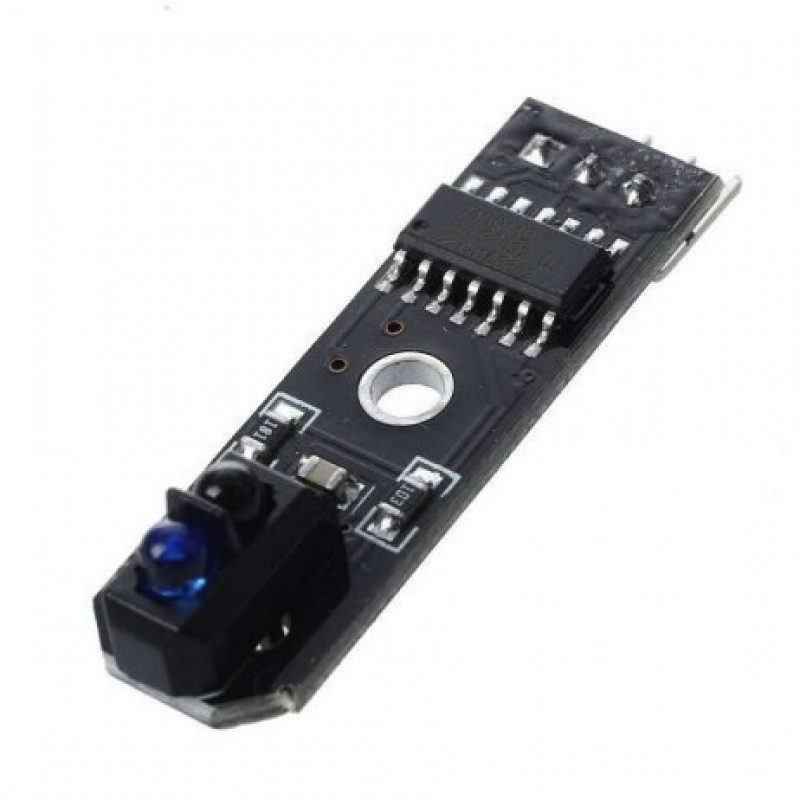
Line-following robots need a way to distinguish a dark line from a light background (or vice versa) using reflected light, and the TCRT5000 does exactly that - an infrared LED emits light downward, and a paired phototransistor measures how much of that light bounces back, with dark surfaces absorbing more light and reflecting less, while light surfaces reflect considerably more back to the sensor.
The module's onboard comparator circuit converts that analog reflectance difference into a clean digital output: low when the sensor is over a black line, high when over a white or light-colored surface, directly readable by a microcontroller's digital input pin without needing analog-to-digital conversion or threshold calculation in firmware. Effective detection distance is rated at 25mm, meaning the sensor needs to sit reasonably close to the surface being read - a detail worth accounting for in a robot chassis's ground clearance design.
Operating on a straightforward 5V supply, the module is compact at roughly 43 x 12 x 14mm with a mounting bolt hole for secure chassis attachment rather than leaving the sensor dangling loose on wires - genuinely important for a sensor that needs to maintain a consistent, close distance from a moving robot's underside to the ground. Compatibility spans Arduino, AVR, ARM, and PIC platforms, reflecting how broadly this reflectance-sensing approach gets used across different robotics projects.
Builders working on a line-following robot, a simple edge-detection system, or any project needing to distinguish reflective surface differences at close range will find the TCRT5000 a well-proven, inexpensive sensor that's become close to a default choice for exactly this kind of reflectance-based sensing task.
| Brand | Generic |
|---|---|
| Output | Digital |
| Selling unit | PCS |