Sold out · Ask us about restocking
Not available to order right now.
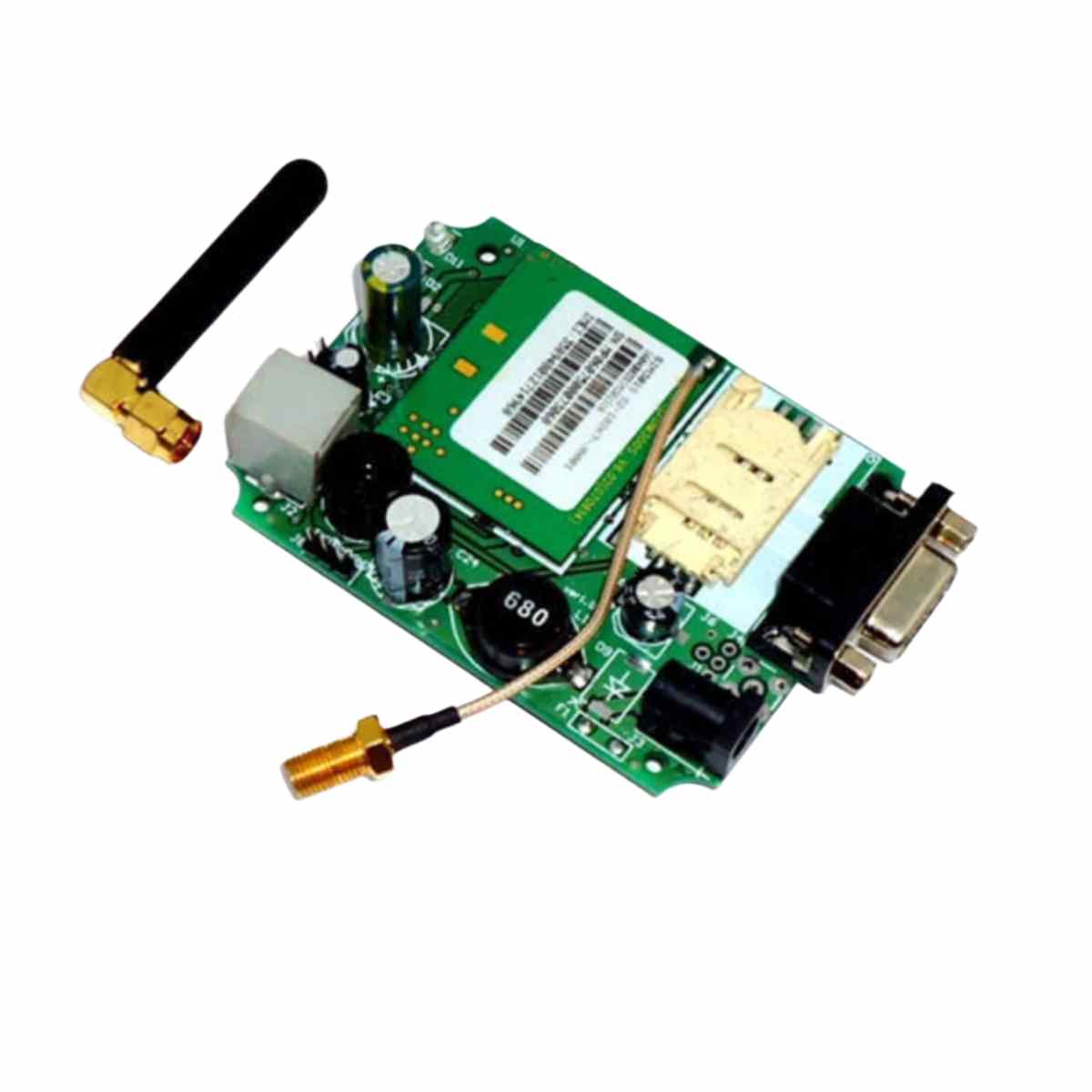
This SIM-300 Quad-Band GSM/GPRS Modem uses the SIMCom SIM300 module and communicates over a serial interface, controlled with standard AT commands. It operates across the 900, 1800 and 1900 MHz bands, and it is compatible with Arduino, Raspberry Pi, ARM, AVR, PIC and 8051 microcontrollers.
It supports data and fax, voice calls, TCP/IP, GPRS and SMS, which makes it a flexible choice for adding cellular connectivity to a project.
The serial baud rate is configurable from 1200 to 115200 bps. The input voltage range is wide, at 7 to 15 V AC or DC, and an antenna is included for reception, connected through an SMA connector for a direct microcontroller connection. Power, ring and network status LEDs show the modem's state at a glance.
Send AT commands from a terminal or your microcontroller code to check the SIM, read signal strength, send an SMS or place a call. Power the module from a clean, adequately rated supply, since radio modules draw current in short bursts that a weak supply cannot follow. Keep the antenna clear of metal and ground planes, and start with the maker's example code before writing your own.
Developers building older-generation cellular projects such as SMS alerts, basic remote monitoring and legacy GSM integrations where 2G/GPRS coverage is still available.
Insert an activated SIM card, connect the antenna, apply a steady voltage in the module's range and open a serial terminal at a matching baud rate. Send a basic AT command first to confirm the module responds, then check network registration and signal quality before trying SMS or a call. Keep antenna and power wiring away from digital lines that could pick up noise.
900, 1800 and 1900 MHz.
With AT commands over a serial interface.
7 to 15 V AC or DC.
Data, fax, voice, TCP/IP, GPRS and SMS.
Arduino, Raspberry Pi, ARM, AVR, PIC and 8051 microcontrollers.
| Brand | Generic |
|---|---|
| Operating Frequency | 900/1800/1900MHz |
| Selling unit | PCS |