Sold out · Ask us about restocking
Not available to order right now.
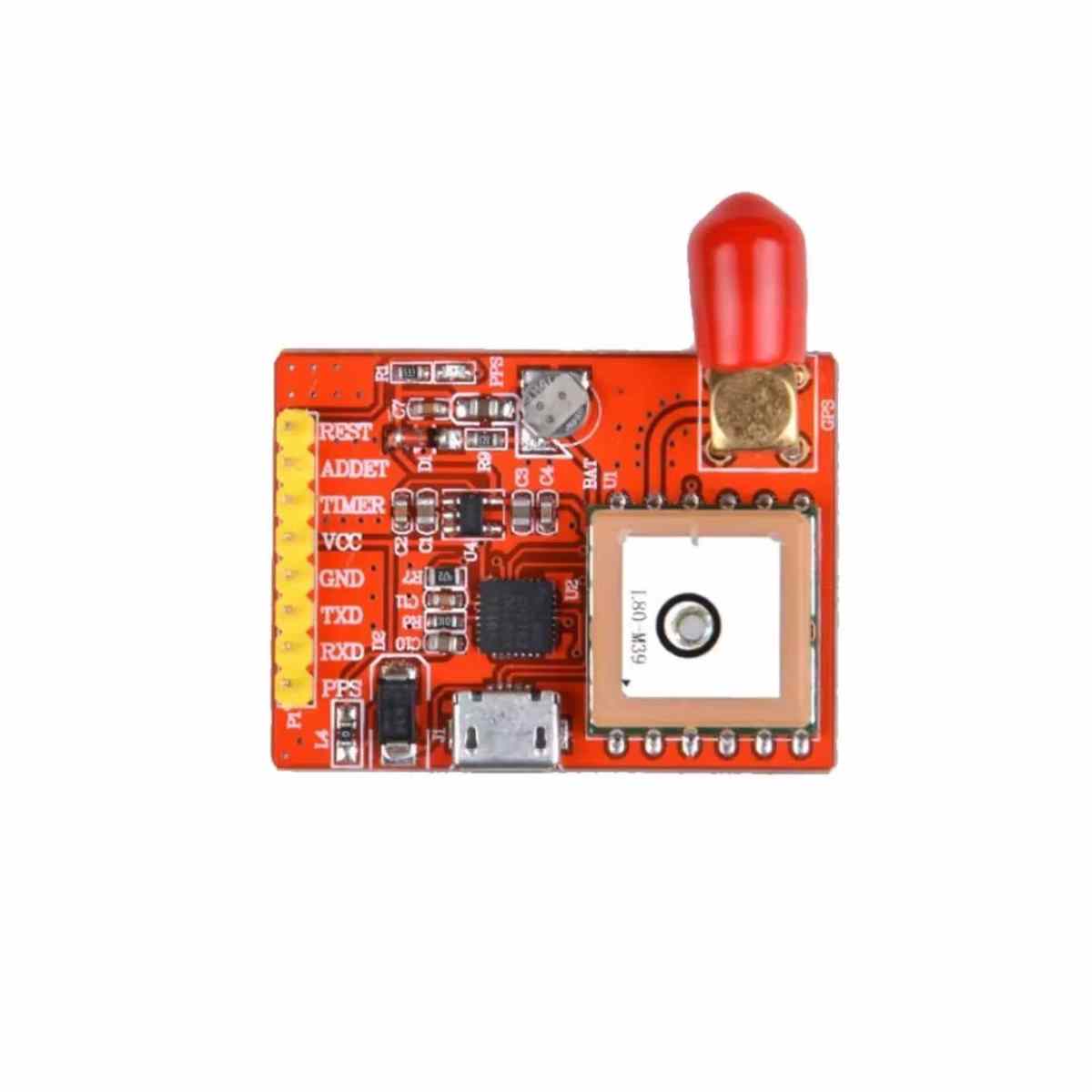
This GPS module for the Raspberry Pi uses the L80-39 receiver with a patch antenna. It includes a USB serial interface chip, so it can talk to a Raspberry Pi through a serial port or USB, and it is listed as compatible with Raspberry Pi models A, B, A+, B+, Zero, 2 and 3.
The module has ultra-low power consumption, fast positioning, capturing and tracking, and it supports self-assisted AGPS (EASY technology) so it does not need external memory.
The receiver has 22 tracking and 66 capture channels, a location precision of 2.5 m CEP and a speed precision of 0.1 m/s. Capture sensitivity is -148 (dBm) and tracking sensitivity is -165 (dBm). It runs from 3.3 to 5 V with a maximum working current of 100 mA, outputs NMEA 0183 data and works from -40 to 85 C. The aerial measures 15 x 15 x 4 mm and the board is red plastic.
It also supports LOCUS data logging, DGPS and SBAS (WAAS, EGNOS, MSAS and GAGAN), plus short-circuit protection and antenna detection. On a Raspberry Pi, the module appears as a serial device that tools such as gpsd can read.
Students and makers adding location to a Raspberry Pi project such as a logger, clock or tracker.
On a Raspberry Pi, plug in the module and check for a device such as /dev/ttyUSB0 or /dev/ttyAMA0. Install gpsd and point it at the device to read the position with tools such as cgps. If you use the serial pins instead of USB, disable the login shell on the serial port first and enable the serial hardware in the Pi configuration.
Raspberry Pi A, B, A+, B+, Zero, 2 and 3.
Through USB, or a serial port.
About 2.5 m CEP.
NMEA 0183.
3.3 to 5 V.
| Brand | Generic |
|---|---|
| Accuracy | 2.5m CEP |
| Channels | 66.000000 |
| Chipset | L80-39 |
| Operating Temperature | -40 to 85 C |
| Operating Voltage | 3.3-5V |
| Supported Protocols | NMEA 0183 |
| Selling unit | PCS |