 1 / 3
Sold out · Ask us about restocking
Not available to order right now.
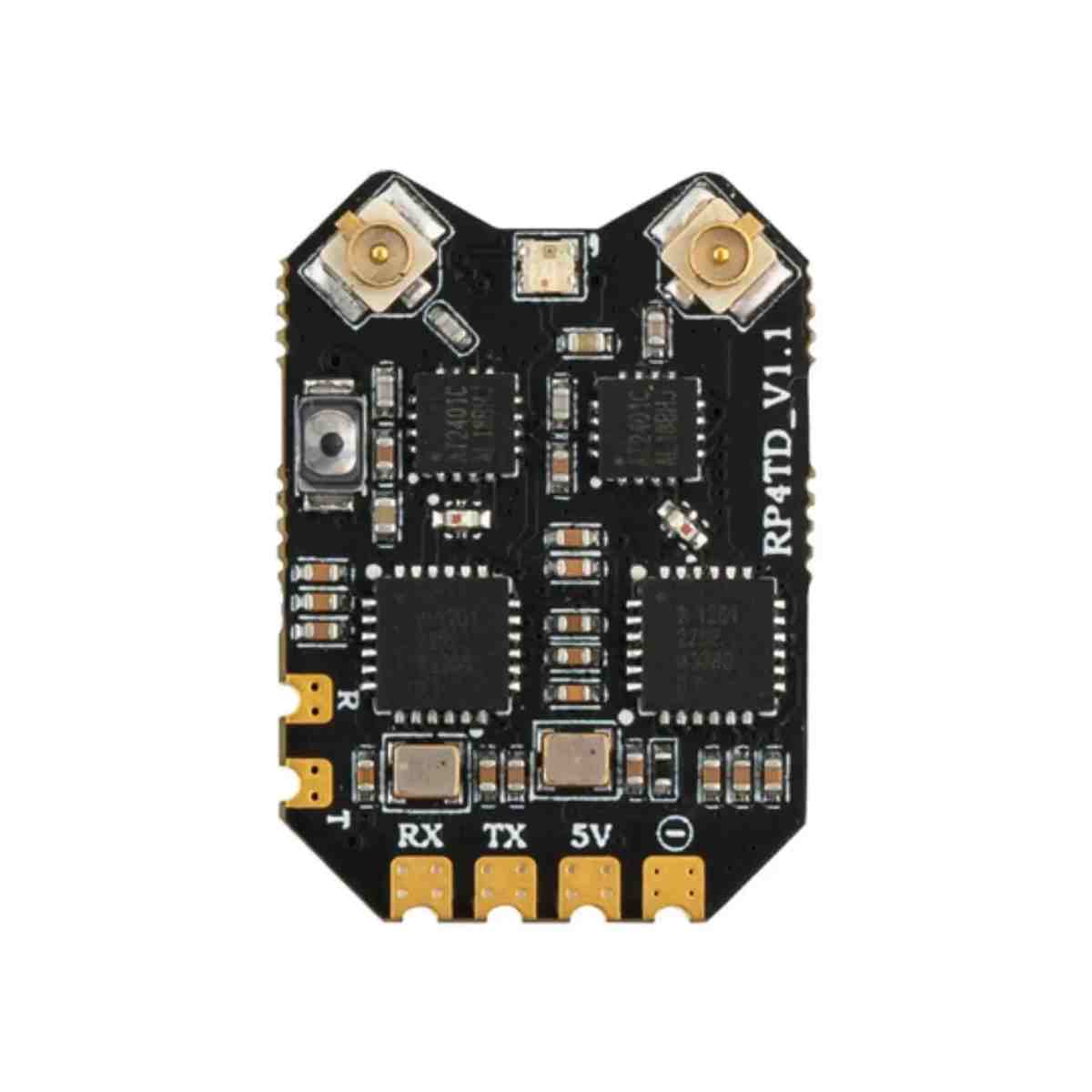
The RadioMaster RP4TD is a nano ExpressLRS 2.4 GHz receiver with true diversity: two antennas and two SX1281 RF chips work together, so it keeps the best signal even as your aircraft banks and turns. Dropouts happen when the antenna is shielded or pointed at the wrong angle, and two antennas placed apart greatly reduce that risk.
It is powered by an ESP32 and ships with ExpressLRS 3.3.0 preinstalled. It supports refresh rates of 500 Hz and F1000 Hz, telemetry power of up to 2 x 100 mW, and it works with all 2.4 GHz ExpressLRS transmitter modules.
The board measures 23.7 x 16.3 x 4.0 mm and weighs 1.4 g without the antennas, which are two 65 mm 2.4 GHz T-antennas. It uses a CRSF bus interface with UART for extended use and accepts 4.5 to 12 V. Mount the two antennas at different angles, ideally 90 degrees apart, to get the best diversity effect. The package includes a CRSF wire and three heat-shrink tubes for the job.
It is also compatible with Gemini mode, so you can pair it with a dual-band Gemini transmitter to use its second radio chip.
If you fly cinematic or long-range setups where a dropout is expensive, yes. On a small indoor quad, a simpler single-antenna receiver will do the job for less.
Place the two T-antennas so they point in different directions, with at least one clear of carbon fibre and battery wiring, because diversity only helps when the antennas see the world differently. Bind it in the usual ExpressLRS way, either with a shared binding phrase set in the firmware or by the power-cycle bind routine, and use the ExpressLRS Lua script on your EdgeTX radio to confirm the packet rate and telemetry settings. If a firmware update is ever needed, the receiver can be updated over Wi-Fi.
ExpressLRS V3.3.0.
Two 65 mm 2.4 GHz T-antennas.
4.5 to 12 V DC.
Yes, it is Gemini mode compatible.
1.4 g without the antennas.
| Brand | Radiomaster |
|---|---|
| Firmware | ExpressLRS V3.3.0 |
| Weight | 1.400000 g |
| Selling unit | PCS |