Sold out · Ask us about restocking
Not available to order right now.
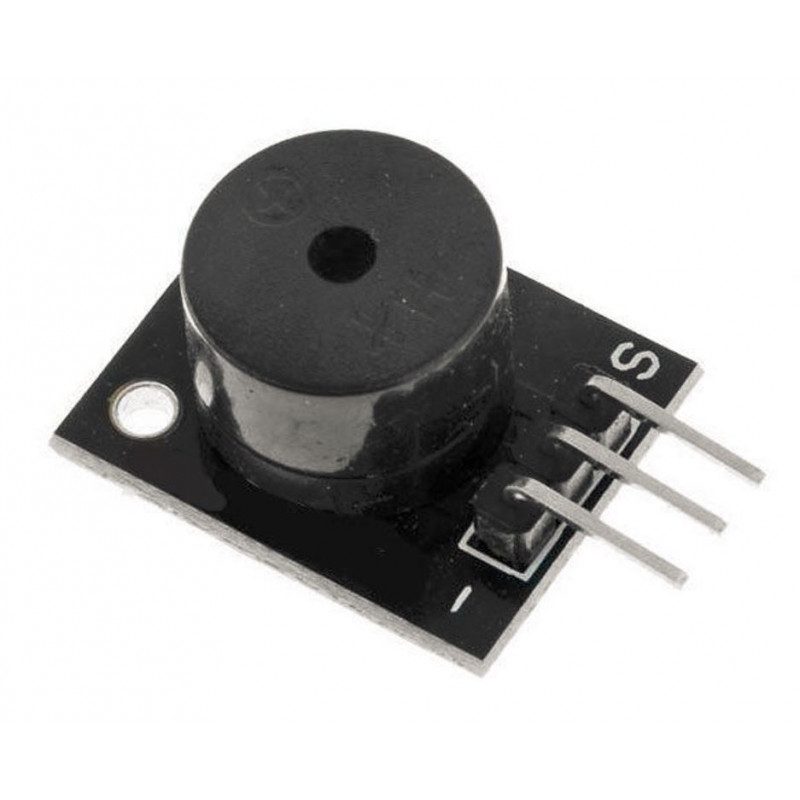
Unlike an active buzzer that produces a single fixed tone whenever it's powered, this passive buzzer module generates a range of sound tones depending on the frequency of the input signal, from 1.5 to 2.5kHz. That means it needs a square wave signal on its input pin, generated in software or through a microcontroller's tone-output function, rather than simply being turned on and off, but in return it can play different pitches and even simple melodies.
It mounts on a small breakout PCB with a standard 2.54mm pin pitch, matching common headers and breadboard spacing, and is designed to be compatible with Arduino and similar microcontrollers without extra interfacing hardware.
The module has three connection points: a GND pin (marked minus), a center pin with no connection, and a digital signal pin labeled S, which is the one connected to whichever pin outputs the square wave tone signal. Operating voltage spans a wide 1.5V to 15V range, and working current stays below 25mA, both comfortably within what a typical microcontroller pin or small power supply can provide.
Physically it measures 26mm by 15mm by 11mm and weighs about 3g, small enough to sit on a breadboard or be tucked into a compact enclosure alongside other components.
Arduino and microcontroller projects that need to play tones, alerts or simple tunes, rather than just a single fixed beep, will get more out of this passive buzzer than an active one, since the pitch itself becomes something the code can control.
A passive buzzer plays a tone based on the input signal's frequency, while an active buzzer produces one fixed tone whenever powered.
1.5 to 2.5kHz.
A square wave on its signal pin, typically generated by a microcontroller's tone function.
1.5V to 15V.
Through GND, an unconnected center pin, and a digital signal pin (S).
| Brand | Generic |
|---|---|
| Selling unit | PCS |