Sold out · Ask us about restocking
Not available to order right now.
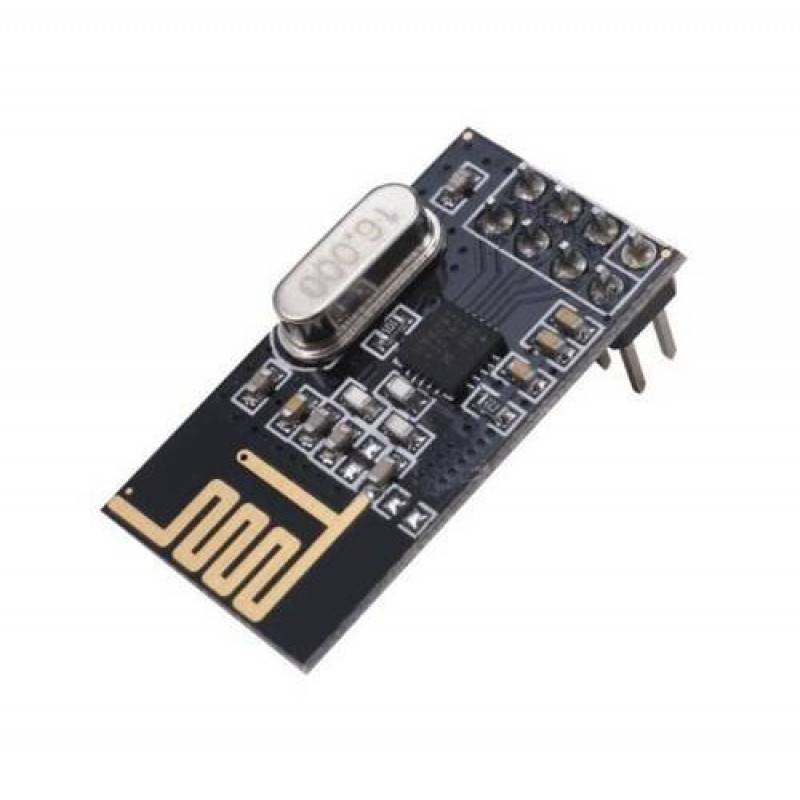
The NRF24L01 is a great little solution for wireless control, capable of up to 2 Mbps communication with a range from 40 to 100 m. It is a universal ISM-band monolithic transceiver chip that works in the 2.4 to 2.5 GHz band, and it measures just 15 x 29 mm.
It supports 125 channels with multi-point communication and frequency hopping, has a built-in 2.4 GHz antenna and can receive on up to six channels at once.
Operating voltage is 1.9 to 3.6 V. Transmit power is 6 dBm, with a transmit current of about 9.0 mA and a receive current of about 12.3 mA. It communicates over SPI and uses the Enhanced ShockBurst protocol engine with GFSK modulation, automatic packet retransmission and an internal FIFO. Frequency channel, output power and air data rate are all configurable in software.
Wire the SPI pins (MOSI, MISO, SCK, CSN and CE) plus power and ground, keeping the power supply clean, since these modules are sensitive to voltage dips when transmitting. Power the module from a clean, adequately rated supply, since radio modules draw current in short bursts that a weak supply cannot follow. Keep the antenna clear of metal and ground planes, and start with the maker's example code before writing your own.
Hobbyists building remote controls, sensor links and simple wireless networks between two or more Arduino or similar boards.
Add a decoupling capacitor close to the module's power pins, since these transceivers are known to be sensitive to supply noise, especially during transmission. If you are seeing missed packets, first check the capacitor and wiring before assuming the module itself is faulty, and keep the antenna away from large metal surfaces and other 2.4 GHz sources such as WiFi routers.
About 40 to 100 m, depending on conditions.
Up to 2 Mbps.
Over SPI.
1.9 to 3.6 V.
Yes, through the Enhanced ShockBurst engine.
| Brand | Generic |
|---|---|
| Frequency | 2.4GHz |
| Selling unit | PCS |