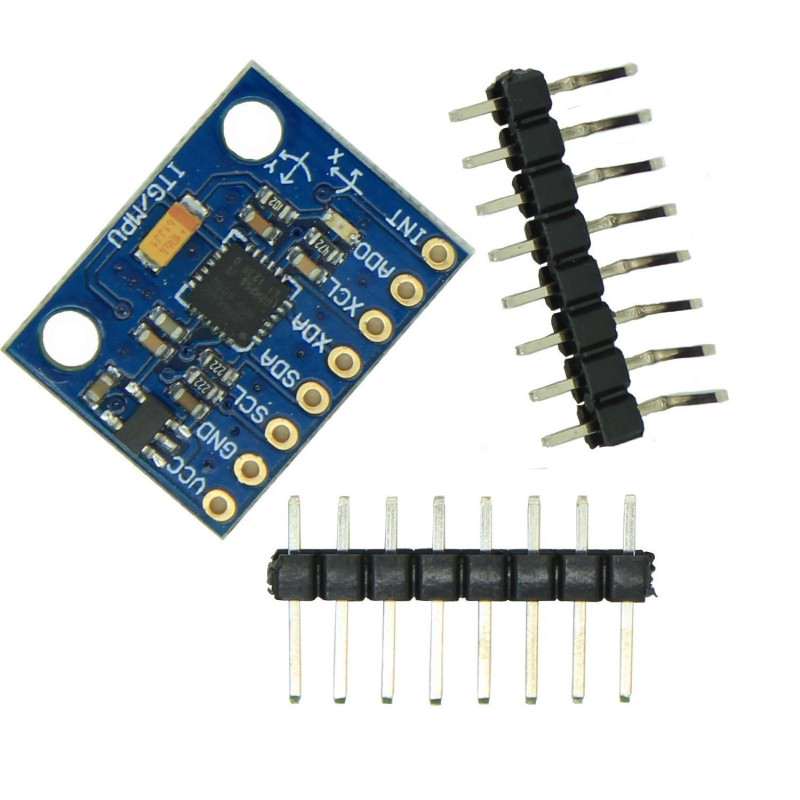
Sold out · Ask us about restocking
Not available to order right now.
The MPU6050 combines two separate sensing elements - a 3-axis gyroscope and a 3-axis accelerometer - onto a single chip with its own onboard digital motion processor, giving a project full 6-axis motion sensing (orientation, rotation rate, and linear acceleration) from one small module rather than wiring up two separate sensor ICs. This combined approach, plus the chip's internal processing capability, has made the MPU6050 one of the most widely used motion sensors in hobby robotics and drone projects for the better part of a decade.
The gyroscope offers four selectable full-scale sensitivity ranges (±250, ±500, ±1000, and ±2000 degrees per second), with sensitivity up to 131 LSBs per degree-per-second at the most sensitive setting, letting a project tune the trade-off between fine rotational resolution and the ability to track fast spins without the readings clipping. The accelerometer similarly offers four programmable full-scale ranges (±2g, ±4g, ±8g, ±16g), covering everything from subtle tilt detection to tracking the hard impacts and rapid accelerations a drone or robot might experience.
Communication runs over a simple digital I2C interface, with built-in pull-up resistors already on the board, and solder jumpers available for configuring the CLK, FSYNC, and AD0 address-select lines to suit a specific wiring setup. An onboard 3.3V low-noise voltage regulator means the module can be powered from a 3.3V to 5V-tolerant supply while the sensing silicon itself runs at its proper voltage internally. A digital-output temperature sensor is also built in, and the chip supports embedded run-time bias calibration, reducing the need for extensive manual calibration routines in firmware.
Builders working on a self-balancing robot, a drone flight controller project, a motion-tracking wearable, or any application needing combined rotation and acceleration sensing from one compact module will find the MPU6050 a well-proven, extensively documented foundation with broad library support across Arduino, ESP32, Raspberry Pi, and most other common microcontroller platforms.
| Brand | Generic |
|---|---|
| Interface Type | I2C |
| Selling unit |
|---|
| PCS |