Sold out · Ask us about restocking
Not available to order right now.
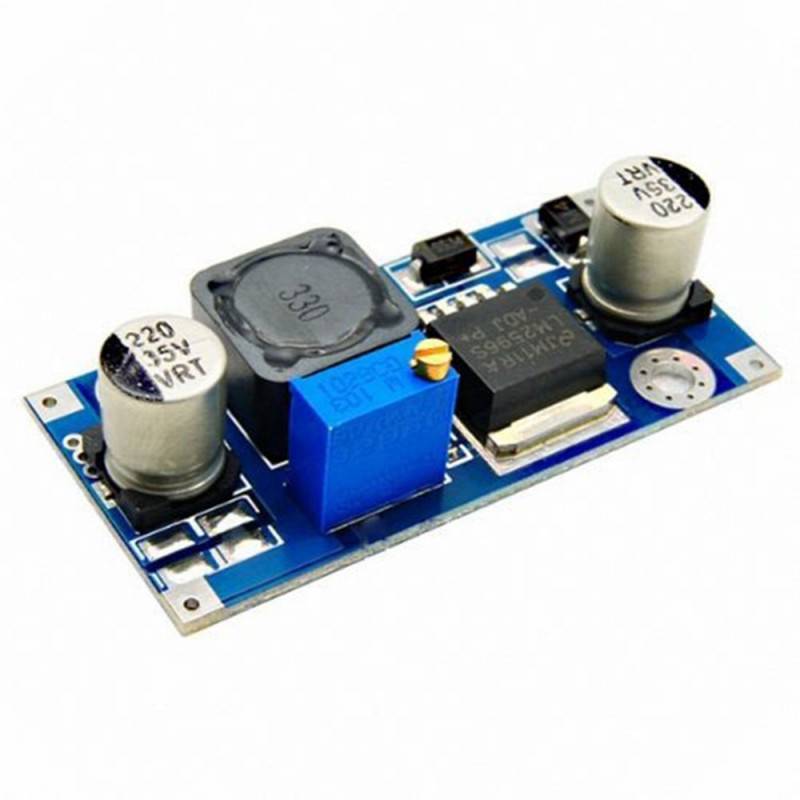
The LM2596 buck converter module steps a higher DC input voltage down to a lower, adjustable output, which is one of the most common jobs in any electronics project where the available power source doesn't match what the rest of the circuit needs. It accepts a wide input range of 3.2V to 40V DC and produces an adjustable output anywhere from 1.25V to 35V DC, set using an onboard trimmer potentiometer.
That flexibility means the same module can be used to bring a 12V or 24V battery supply down to a 5V logic rail, or trim a slightly-too-high voltage down to exactly what a sensitive component needs, all from one small board rather than needing a different fixed-voltage regulator for each situation.
Standard output current is 2A, with a maximum of 3A achievable if additional heat sinking is added to the module, since running near the top of its current range generates meaningful heat in the regulator chip. The board measures 43mm by 20mm by 15mm, small enough to fit inside most project enclosures without dominating the available space.
One important note directly from the module's own specification: the input voltage must be higher than the desired output voltage by at least 1.5V, since a buck converter can only step voltage down, not up, and needs that margin to regulate properly.
Anyone powering a project from a battery pack or supply voltage that doesn't match what their electronics need, whether stepping a 12V source down to 5V logic or adjusting a supply to a specific sensor's requirement, will find this adjustable module a versatile, reusable part across many different projects.
3.2V to 40V DC.
1.25V to 35V DC, adjustable.
2A continuously, up to 3A with additional heat sinking.
Through an onboard trimmer potentiometer.
Yes, input voltage must be at least 1.5V higher than the desired output voltage.
| Brand | Generic |
|---|---|
| Input Voltage | 3.2-40V DC |
| Output Voltage | 1.25-35V DC (Adjustable) |
| Selling unit | PCS |