Sold out · Ask us about restocking
Not available to order right now.
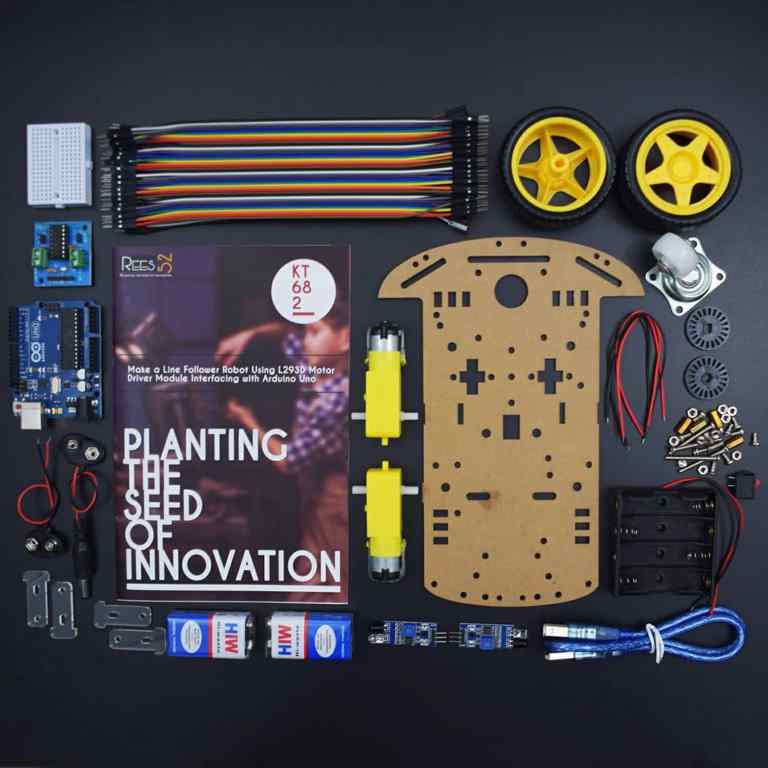
This kit lets you build a line follower robot using an Arduino Uno, an L293D motor driver module and IR sensors. A line follower is one of the classic first robotics projects: two sensors watch the floor, the Arduino compares them and the motor driver steers the robot to keep it on a dark line.
The kit includes the Arduino Uno with a USB cable, two IR sensor modules, 40 male-to-male and 40 male-to-female jumper wires, two 9V batteries, a snapper with a DC jack, a snapper, a 170-point breadboard, the L293D motor driver module and a two-wheel car chassis.
The L293D module works from a 5 V supply with a motor supply up to 36 V, gives 600 mA per channel (1.2 A at the highest) and has thermal shutdown and a separate logic supply. Each IR sensor runs on 3.3 to 5 V, detects at 2 to 30 cm (adjustable with a potentiometer) and draws about 23 mA at 3.3 V or 43 mA at 5 V. The output goes low when an obstacle is detected.
Start by wiring the motors to the driver and testing them, then test each sensor and adjust its potentiometer on the floor you will use. Finally, write a small program that turns toward the side that sees the line. Use a black tape line on a light floor for the first tests.
Students and beginners who want a guided robotics project with Arduino, and teachers looking for a low-cost classroom build.
Place the two IR sensors at the front, close to the floor, so that they straddle the line. Adjust each sensor's potentiometer until it detects the line but not the floor. If the robot wobbles, slow the motors or add a short delay, and if it loses the line at corners, try mounting the sensors a little wider apart.
An Arduino Uno.
Two.
An L293D motor driver module.
From 2 to 30 cm, adjustable.
Yes, two 9V batteries.
| Brand | Generic |
|---|---|
| Selling unit | PCS |