Standard checkout available. Verified maker dispatch.
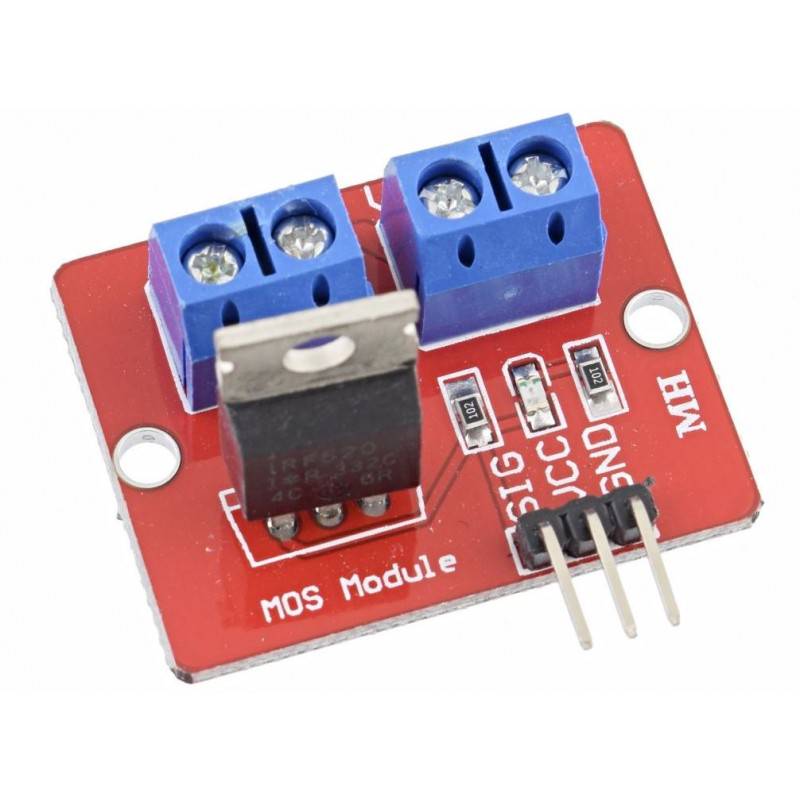
A microcontroller's GPIO pin can supply a logic-level signal but can't directly drive a motor, pump, or LED strip pulling real current - the IRF520 driver module bridges that gap, using a MOSFET to switch a higher-current, higher-voltage load based on a simple low-current logic signal from an Arduino, Raspberry Pi, or similar board.
The module accepts either 3.3V or 5V logic-level trigger signals, covering both common microcontroller logic families directly without needing a separate level-shifting stage. Load-side output voltage can range from 0 to 24V, and output current is rated under 5A, though the module's documentation is clear that a heatsink needs to be added for any load drawing 1A or more, since the MOSFET will generate meaningful heat at higher sustained currents without additional cooling.
Because it's switching through a MOSFET rather than a mechanical relay, switching happens silently and without any contact wear over repeated cycles, making it well suited for applications doing frequent or rapid switching (like PWM-based motor speed control or LED dimming) where a mechanical relay's limited switching lifespan and audible clicking would be a real drawback. The board measures a compact 33 x 24mm, easy to fit into most project enclosures.
Documented compatibility spans Arduino, generic MCU platforms, ARM boards, and Raspberry Pi, reflecting how broadly this module gets used across different microcontroller ecosystems. Builders needing to switch a DC motor, water pump, LED strip, or other moderate-current load directly from a microcontroller's GPIO pin - without the switching noise, contact wear, or relatively slow response of a mechanical relay - will find the IRF520 a well-proven, simple solution for that job.
| Brand | Generic |
|---|---|
| Output Current | up to 5A |
| Output Voltage | 0-24V |
| Selling unit | PCS |