 1 / 4
Sold out · Ask us about restocking
Not available to order right now.
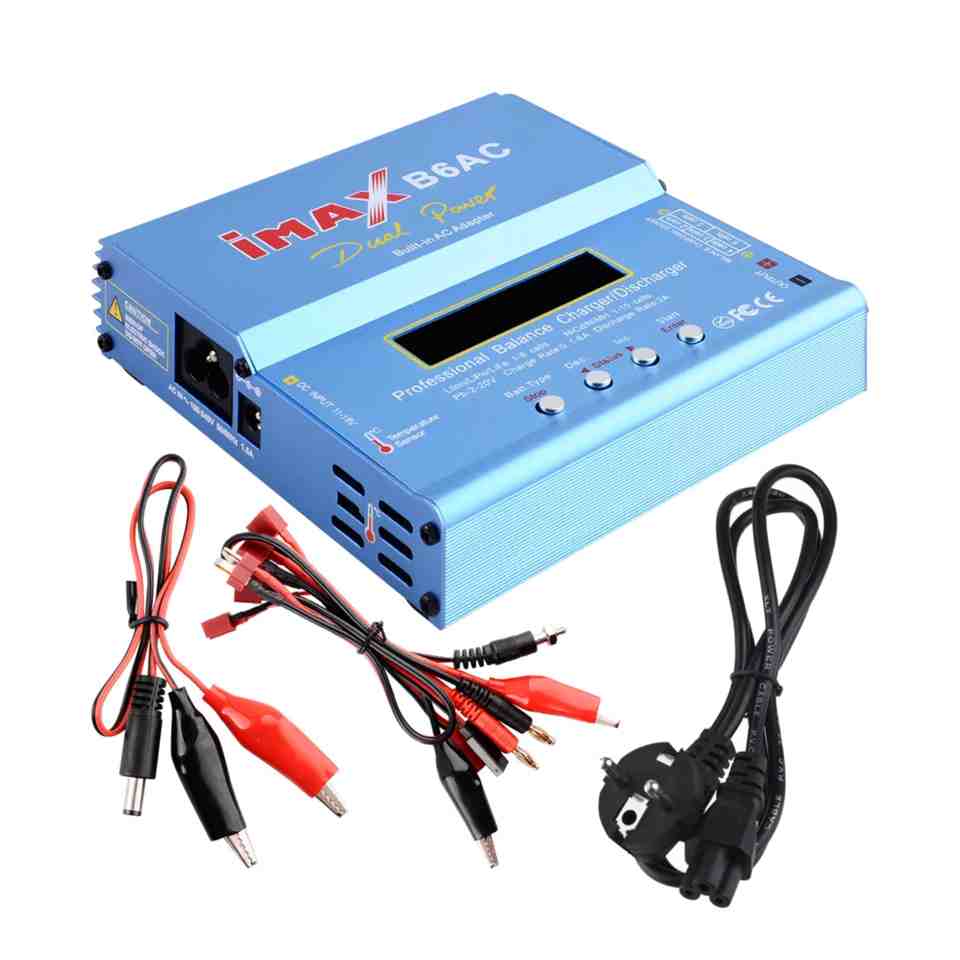
The iMAX B6AC is a microprocessor-controlled charger for a wide range of battery chemistries. It charges, balances and discharges Li-ion, LiPo, LiFe (A123), NiCd and NiMH cells, including individual cell balancing for lithium packs.
This 80W charger handles packs up to 6S, includes input voltage protection and a storage charge mode, and can be powered from any 11-18V DC source or from AC mains. That flexibility is why the B6AC is such a common sight on RC and drone workbenches and in field boxes.
Its JST-XH charge plug fits many battery brands, including Zippy, HXT and Loong Max, and any pack with a JST adapter, so most hobby batteries can be balance charged without extra hardware.
AC 100-240V or 12V DC input: run it from the wall at home or from a car or field battery.
Fitted safety fuses: built-in protection for the charger and your packs.
Microprocessor-controlled charging: accurate control of every charge and discharge cycle.
Multi-chemistry: supports Li-ion, LiPo and LiFe, plus NiCd and NiMH.
Input voltage monitoring: protects the power source, such as a car battery, from being drained.
5 battery pack profiles in memory: store your favourite settings and recall them quickly.
Internal resistance checker: a quick indicator of pack health.
Individual cell balancing: keeps the cells of a lithium pack even.
A smart charger does more than push current into a battery. A microprocessor monitors voltage and current throughout the cycle, follows the charge profile that suits the battery chemistry and stops when the pack is full. For lithium packs, a balance connector lets the charger see each cell separately, so it can keep the cells at the same voltage.
Always set the charger to the correct chemistry and cell count, charge on a fire-safe surface and never leave a lithium battery charging unattended.
Good charging habits matter as much as the charger itself. Check that the battery is not puffed or damaged, let a warm battery cool down before you charge it, use a lead that matches the connector and keep the charge current within the limit recommended for the pack. Storing lithium batteries at a partial charge instead of full also helps them last longer, so use a storage function or discharge mode if you will not fly for several days.
Charging LiPo packs for FPV quadcopters and multirotors
Balance charging 2S to 6S packs at home or in the field
Discharging or storage-charging packs before a long break
Battery break-in and cycling for NiCd and NiMH packs
Checking pack condition with the internal resistance function
The charger accepts AC 100-240V or an 11-18V DC source. An EU plug to IEC C13 power cable is included in the box, together with the charge leads listed below.
Use the charge lead that matches your battery connector, connect the balance lead for lithium packs and verify cell count on the screen before starting a charge.
Charge current range: 0.1 to 5A
Discharge current range: 0.1 to 1.0A
Cells: 1 to 6
Input voltage: 110-240V AC
Output power: 80W
Balancing drain current: 300mA per cell
NiCd/NiMH cells: 1-15
Pb battery voltage: 2-20V
1 x iMAX B6AC charger
1 x 100-250V power supply cord
1 x T plug with banana connector cable
1 x DC cable with alligator clip
1 x T plug with alligator clip
1 x T plug with Futaba connector cable
1 x T plug with JST connector cable
1 x user manual
RC and drone hobbyists who need a versatile AC/DC charger and balancer for multiple battery types.
Lithium packs up to 6S, and NiCd or NiMH packs up to 15 cells.
Yes. It accepts 11-18V DC and monitors the input voltage to protect the source.
Yes, with individual cell balancing for lithium packs.
Up to five.
The listing gives a charge current range of 0.1 to 5A.
The charger, an AC cord, charge leads for banana, alligator clip, Futaba and JST connections, and a manual.
| Brand | iMax |
|---|---|
| Cell Configuration | 1-6 cells (Li); NiCd/NiMH 1-15 |
| Charge Current | 0.1-5 A |
| Discharge Current | 0.1-1.0 A |
| Input Voltage | 110-240V AC / 11-18V DC |
| Power | 80W |
| Selling unit | PCS |