Sold out · Ask us about restocking
Not available to order right now.
A raw load cell produces an extremely small differential voltage signal, far too weak and noisy for a microcontroller's standard analog input to read accurately on its own - the HX711 solves exactly this problem, combining a precision 24-bit analog-to-digital converter with a programmable gain amplifier specifically designed to pick up and digitize that tiny load cell signal cleanly.
The chip handles a differential input range of plus or minus 40mV at full scale, with an internal gain stage amplifying the signal up to 128 times before conversion, letting it resolve the genuinely small voltage changes a load cell produces as weight is applied. Two analog input channels are supported, giving flexibility for projects using more than one load cell or needing a reference channel alongside the main measurement. Output data rate is selectable between 10Hz and 80Hz, trading measurement speed against noise filtering depending on what an application needs.
Communication with a host microcontroller happens over a simple two-wire interface (clock and data), notably not standard I2C or SPI but close enough in concept that reading the chip is still straightforward with the right library - mature libraries exist for Arduino, ESP32, and most other common microcontroller platforms, making integration considerably easier than implementing the HX711's specific timing protocol from scratch. Operating voltage spans 2.7V to 5VDC, with current draw under 10mA, modest enough for battery-powered scale projects.
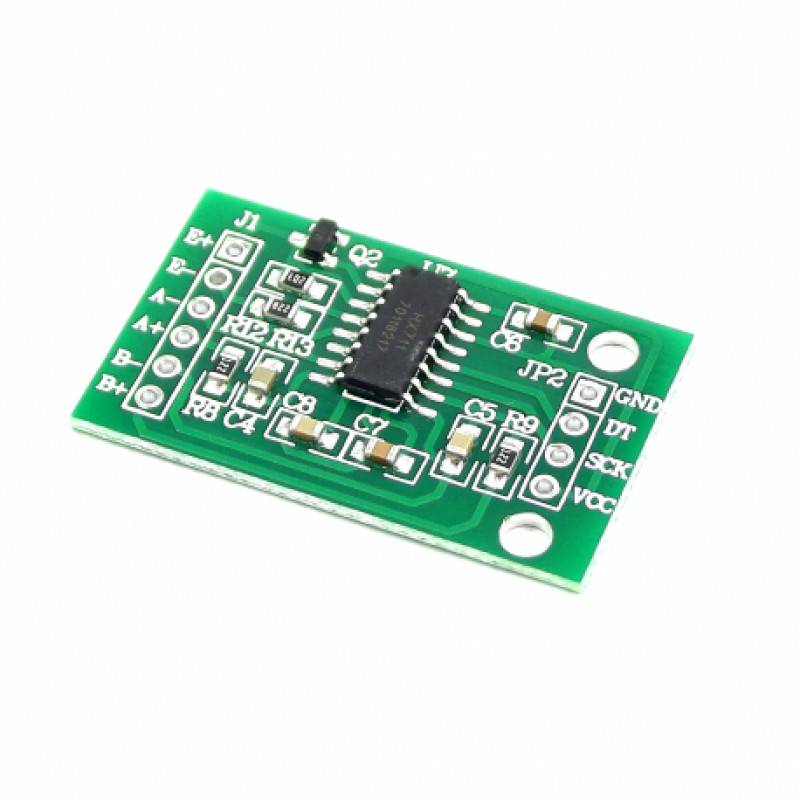
The board itself is compact at just 24x16mm. Builders working on a DIY digital scale, a force-measurement project, a weight-triggered trigger or alert system, or any application needing to convert a load cell's analog signal into precise, readable digital weight data will find the HX711 the de facto standard component for that exact job.
| Brand | Generic |
|---|---|
| Channels | 2.000000 |
| Selling unit | PCS |