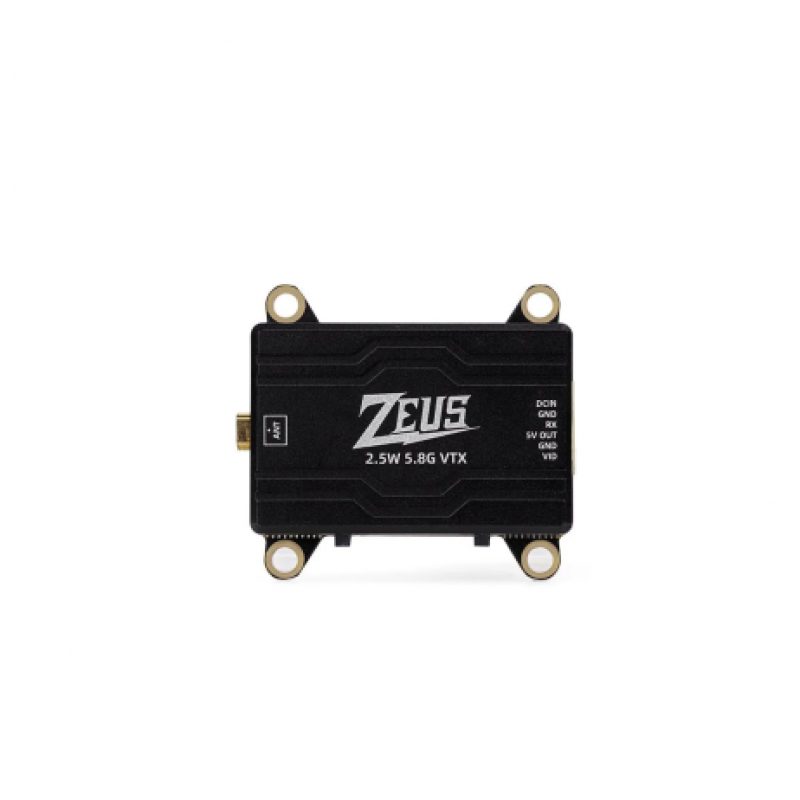
The HGLRC Zeus VTX 2.5W is a long-range analog video transmitter built for FPV racing and freestyle quadcopters that need real reach without a separate booster. Its headline feature is adjustable output across six levels, from a near-silent Pit mode through 25, 200, 800 and 1600mW up to the full 2500mW, all switchable in flight through the IRC Tramp protocol from a compatible OSD or radio. HGLRC rates it for roughly 9km of range in built-up areas with heavy RF interference, extending past 10km in open suburban or mountainous terrain, figures that put it firmly in the long-range class rather than typical park-flying VTXs.
Power input covers 2-6S (7-26V), so it runs directly off the main flight battery on most builds without a separate regulator, and a 5V/800mA BEC output is available for powering a camera or other low-voltage accessory from the same board. Forty channels are spread across the standard A/B/E/F/R frequency groups, selected through dual onboard buttons with three LED indicators showing power level, frequency group and channel at a glance, useful when a quick change is needed without plugging into a laptop. The housing uses a CNC-machined aluminium shell on both the top and bottom half specifically for heat dissipation, since running at 2.5W for any length of time generates real warmth that a plastic case would struggle to shed.
Connections use an MMCX antenna port and a GH1.25 6-pin cable, and the board mounts on the increasingly common 30.5x30.5mm M3 pattern used across most modern FPV stacks. At 40x35x11.8mm and 19.6g, it adds a reasonable but not negligible amount of weight for a long-range VTX, which buyers building a lightweight freestyle quad should factor in against the smaller Zeus Nano variant.
Pilots flying genuine long-range missions, or anyone who has outgrown a 25-200mW VTX and needs real penetration through buildings and terrain, will get the most from the Zeus VTX 2.5W. For a typical park or small-field freestyle quad where local power limits apply anyway, the smaller, lighter Zeus Nano is the more sensible choice.
 1 / 5