 1 / 2
Sold out · Ask us about restocking
Not available to order right now.
The DJI Naza-M Lite is a multi-rotor flight controller system. The page says its advanced attitude stabilisation algorithm gives stability for entry-level drone enthusiasts, and that plug-and-play GPS integration enables position and altitude locking in windy conditions.
The specification list gives an input voltage of 8V~5.5V (as printed), a maximum power consumption of 1.5W, a normal power consumption of 0.6W, an ESC output refresh frequency of 400Hz, a 3-axis gyroscope, a 3-axis accelerometer, a barometer and an inner damping system. At the time of the check the page showed it as sold out (SKU TIFQC0029).
Attitude stabilisation algorithm: stability for entry-level pilots.
3-axis gyro, 3-axis accelerometer and barometer: as listed.
Auto-pilot and altitude measurement: as listed.
400 Hz ESC output refresh: as listed.
2-axis gimbal support: built-in gimbal stabilisation.
Failsafe and low-voltage protection: as listed.
A flight controller is the brain of a multirotor or fixed-wing aircraft. It reads the gyroscope, and where fitted the accelerometer, barometer and compass, and runs a control loop that compares what the aircraft is doing with what the pilot asks for. It then sends new speed commands to the motors through the ESCs or servos many times each second. A faster processor and a better gyro allow a higher loop rate and a more locked-in feel.
Wiring and firmware decide what the board can do. The number of UARTs limits how many receivers, GPS units, telemetry radios and video systems you can connect, the PWM or motor outputs limit how many motors and servos it can drive, and the input voltage range must suit your battery and power module. Before you buy, check that the firmware you want to run supports the board and that its mounting pattern fits your frame.
Set up carefully. Flash a firmware that is listed as supported, configure the receiver protocol, set the motor order and direction, calibrate the accelerometer and, for larger aircraft, the compass, and always test with the propellers removed first. Keep the board isolated from vibration with soft mounts where the design calls for them, and never power it with a supply that is outside the rated input voltage.
Keep the aircraft safe. Confirm your failsafe settings and arming switch before the first flight, keep a backup of your configuration, and update firmware only when you have a reason to. A flight controller is a safety-critical part, so use the wiring diagram from the maker and avoid guesswork with power connections.
Entry-level multirotors
GPS position hold builds
Aerial photography with a 2-axis gimbal
Failsafe-return setups
DJI-based systems
The page lists built-in gimbal stabilisation compatible with 2-axis gimbal systems, failsafe mode and low-voltage protection. If the transmitter link is lost, the failsafe returns all control sticks to centre.
The input voltage is printed as 8V~5.5V, which looks reversed, so check the range with the seller before you power the unit.
Input voltage: 8V~5.5V (as printed)
Maximum power consumption: 1.5W
Normal power consumption: 0.6W
Sensors: 3-axis gyroscope, 3-axis accelerometer, barometer
ESC output refresh frequency: 400Hz
Gimbal: built-in stabilisation for 2-axis gimbals
Failsafe and low-voltage protection
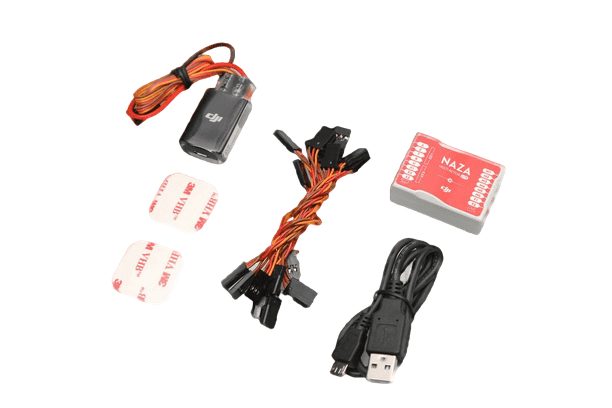
1 x DJI Naza controller unit
1 x Remote LED module
1 x Power module
1 x USB to MicroUSB cable (18 inches)
8 x Servo cables (5 inches each)
1 x Double-sided tape set
Entry-level multirotor builders who want a simple stabilised flight controller.
A 3-axis gyroscope, 3-axis accelerometer and a barometer.
400 Hz.
Yes, 2-axis gimbal systems.
The controller, LED module, power module, USB cable, 8 servo cables and tape.
| Brand | DJI |
|---|---|
| Gimbal Support | 2-axis |
| Input Voltage | 8V-5.5V |
| Power Consumption | 1.5W max, 0.6W normal |
| Refresh Frequency | 400.000000 Hz |
| Sensors | 3-axis gyroscope, 3-axis accelerometer, barometer |
| Weight | 500.000000 g |
| Selling unit | PCS |