Sold out · Ask us about restocking
Not available to order right now.
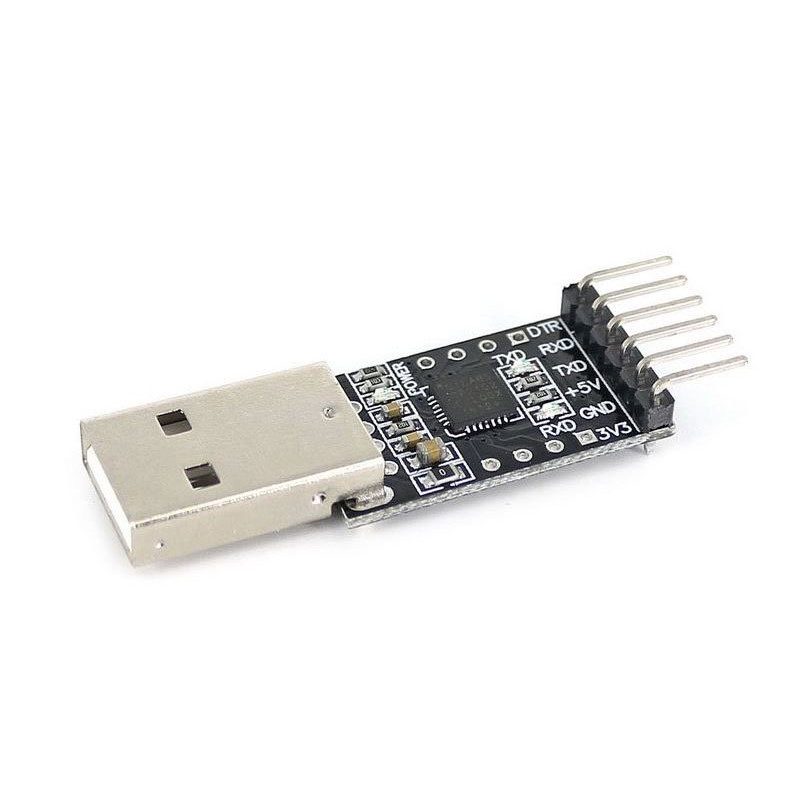
This CP2102 module is a USB-to-serial converter that attaches to a computer's USB bus and appears as a standard COM port, making it one of the most common ways to connect a microcontroller's TX and RX pins to a computer for programming, debugging or general serial communication. Because the USB transceiver itself is included on the chip, no external circuit components are needed to make the USB side of the conversion work.
It provides dual power output at both 3.3V and 5V, so the same module can supply power directly to either a 3.3V-class board like many ESP-series modules, or a 5V-class board like a classic Arduino Uno, without needing a separate regulator.
Baud rates run from 300bps up to 921600bps, a wide enough range to cover everything from very old, slow serial devices up to fast modern microcontroller serial links, and the module includes 512-byte receive and transmit buffers to help absorb bursts of data without losing bytes. It supports 8 data bits, 1 stop bit, and configurable parity options, matching the settings most serial devices expect.
Three LEDs are fitted: a power indicator, a data reception indicator, and a data transmission indicator, giving an immediate visual sense of whether the module is powered and actively sending or receiving data. A self-recovery fuse protects the USB port itself from a wiring fault or short circuit. The board measures 42mm by 16mm by 6mm and weighs 4g.
Anyone programming or debugging a bare microcontroller, an ESP8266/ESP32 board without onboard USB, or any project needing a simple USB-to-serial bridge will find the CP2102 module a standard, well-supported way to do it.
A standard COM port.
Both 3.3V and 5V, selectable dual output.
300bps up to 921600bps.
Three: power, data reception and data transmission.
Yes, with a self-recovery fuse.
| Brand | Generic |
|---|---|
| Chipset | CP2102 |
| Selling unit | PCS |