Sold out · Ask us about restocking
Not available to order right now.
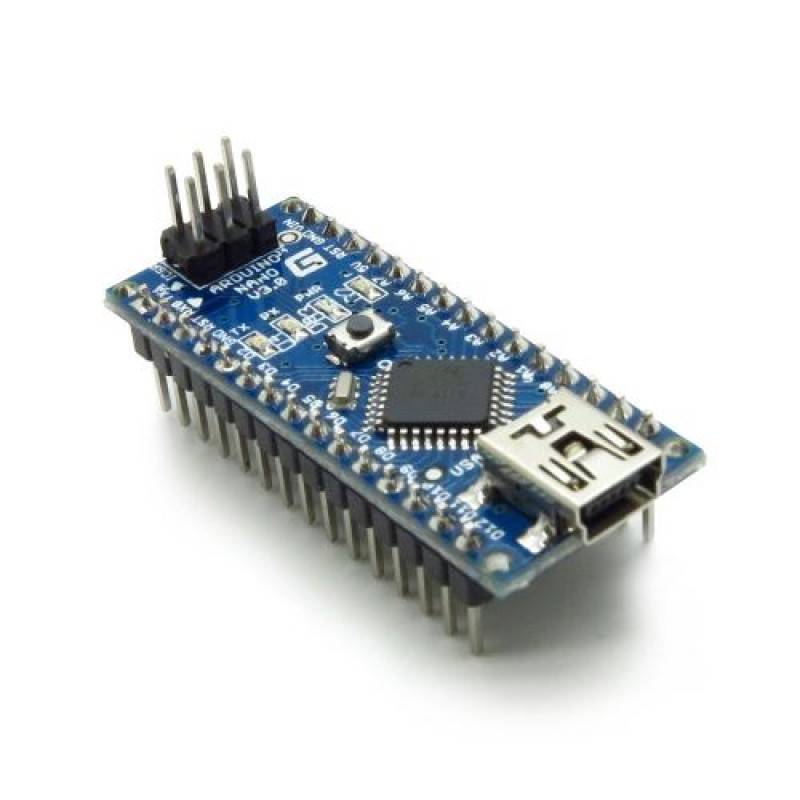
The Nano V3.0 is an open-source, compact embedded development board built around the Atmel ATmega328 in its SMD package, designed as a clone-compatible alternative to the original Arduino Nano. It keeps the same basic layout that makes the Nano popular for breadboard work: a narrow body that plugs directly into a solderless breadboard while leaving header pins accessible on both sides.
Power is supplied through a Mini USB port for programming and running the board, and the board automatically switches between USB power and an external supply connected to its input pins, so no manual jumper setting is needed when moving between bench testing and a battery-powered project.
It runs at a 5V operating voltage, with a recommended input voltage of 7 to 12V and an absolute limit of 6 to 20V for external power. There are 14 digital I/O pins, of which 6 provide PWM output, and 8 analog input pins, giving more analog channels than a standard Uno-style board. Each I/O pin can supply up to 40mA of current.
Onboard memory is 32KB of flash, of which 2KB is used by the bootloader, alongside 2KB of SRAM and 1KB of EEPROM, and the clock runs at 16MHz. The board measures 0.70 by 1.70 inches.
Hobbyists and students building small robotics, sensor or automation projects who want an Arduino Nano-style footprint on a breadboard will find this board a straightforward, low-cost option. Its extra analog inputs compared to an Uno make it useful when a project needs to read several sensors without adding a multiplexer.
The Atmel ATmega328 in an SMD package.
14 digital I/O pins, 6 of which support PWM, plus 8 analog input pins.
5V operating voltage, with a recommended input of 7 to 12V.
32KB of flash, of which 2KB is used by the bootloader.
Through Mini USB, or from an external supply, switching between the two automatically.
| Brand | Generic |
|---|---|
| Flash Memory | 32KB |
| MCU / Processor | ATmega328 (SMD) |
| Operating Voltage | 5V |
| Selling unit | PCS |