Standard checkout available. Verified maker dispatch.
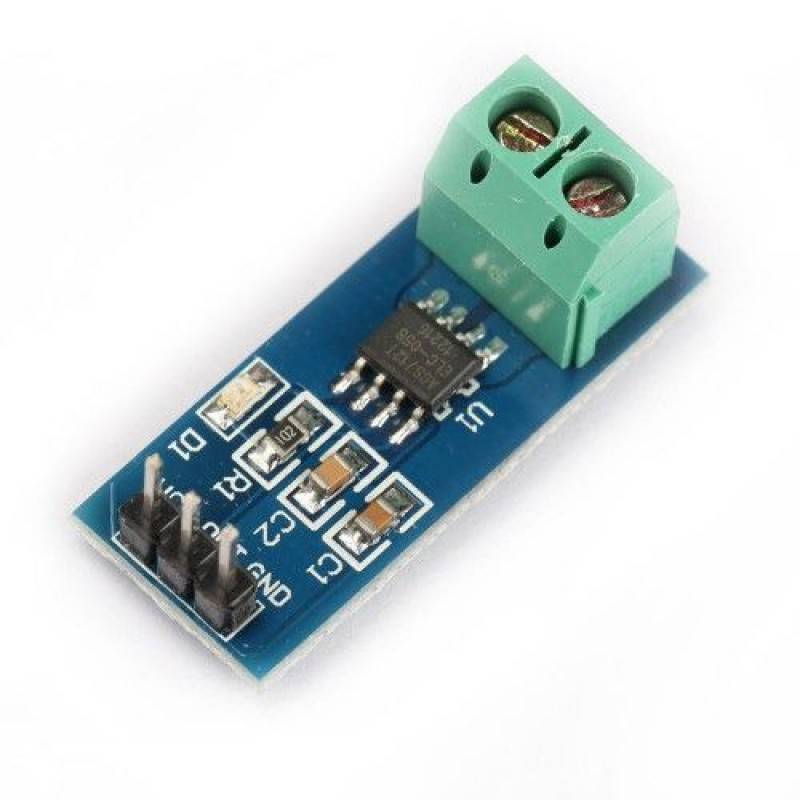
The ACS712 is a Hall-effect current sensor that measures current by sensing the magnetic field generated by current flowing through an internal conductor, rather than requiring the circuit to be broken and a shunt resistor inserted directly in the measurement path - meaning the sensor itself sits in-line but introduces minimal additional resistance into the circuit being measured.
This 20A-range version covers current measurements from -20A to 20A, with negative readings corresponding to current flowing in the reverse direction, making it equally capable of measuring both AC and DC current depending on how a project interprets the output. Sensitivity is rated at 100mV/A, meaning the analog output voltage shifts 100 millivolts for every amp of current measured, a figure a connected microcontroller's ADC converts back into an actual current reading through straightforward math.
Output is a simple analog voltage read directly through any microcontroller's analog input pin, requiring no special communication protocol or library beyond basic ADC reading and the sensor's known sensitivity figure - about as simple an interface as a current sensor can offer. Supply voltage is a standard 4.5 to 5.5V, matching common 5V logic rails without needing a separate regulator.
Typical applications include overcurrent protection circuits that cut power when a measured current exceeds a safe threshold, battery and power-usage monitoring for solar or off-grid projects, and general current-logging for understanding how much power a circuit or appliance actually draws under real conditions. Builders working on a power monitoring project, a DIY overcurrent cutoff, or simply wanting to measure how much current a circuit draws without breaking it open for a multimeter probe will find the ACS712 a straightforward, well-documented sensor to work with.
| Brand | Generic |
|---|---|
| Selling unit | PCS |