Sold out · Ask us about restocking
Not available to order right now.
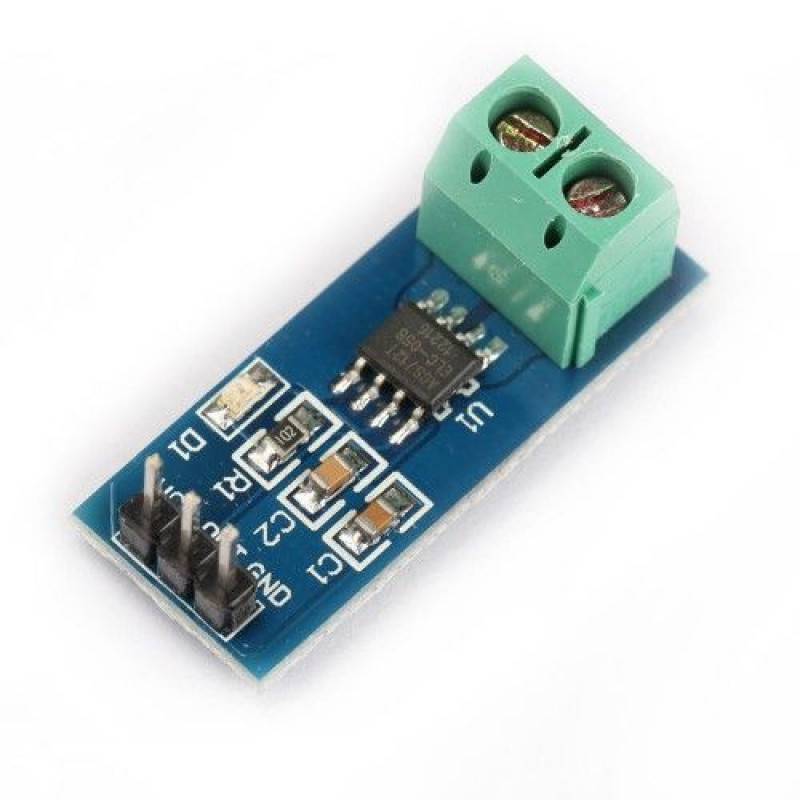
This current sensor module is built around the ACS712 chip, which uses the Hall effect to sense the magnetic field generated by current flowing through an internal conductor, allowing it to accurately detect AC or DC current without needing to insert a resistive shunt directly into the measured circuit. This particular version can sense up to 20A of current flow, in either direction for DC or across the full AC waveform.
Output sensitivity is 100mV per amp, meaning the sensor's analog output voltage changes by 0.1V for every 1A of current measured, a straightforward, linear relationship that makes converting the raw analog reading back into an actual current value in code relatively simple.
Supply voltage runs from 4.5V to 5.5V DC, matching standard Arduino and similar microcontroller logic rails directly, so no separate power supply or level shifting is needed to use it. The measurable current range covers -20A to +20A, covering the current draw of many small motors, LED strips, appliance circuits and power supplies within a hobby or light industrial context.
Because it measures current inductively rather than resistively, it introduces negligible additional resistance into the circuit being monitored, which matters for measurements where even a small extra voltage drop could affect the circuit's behaviour.
Anyone building a power monitoring project, a battery management system, or a circuit that needs to detect overcurrent or measure power draw on a motor or appliance will find this ACS712 module a straightforward way to add current sensing without disrupting the circuit being measured.
-20A to +20A, for both AC and DC.
100mV per amp.
4.5V to 5.5V DC.
Through the Hall effect, sensing the magnetic field from current flow rather than a resistive shunt.
No, its inductive sensing method adds negligible extra resistance.
| Brand | Generic |
|---|---|
| Chipset | ACS712 |
| Selling unit | PCS |