Sold out · Ask us about restocking
Not available to order right now.
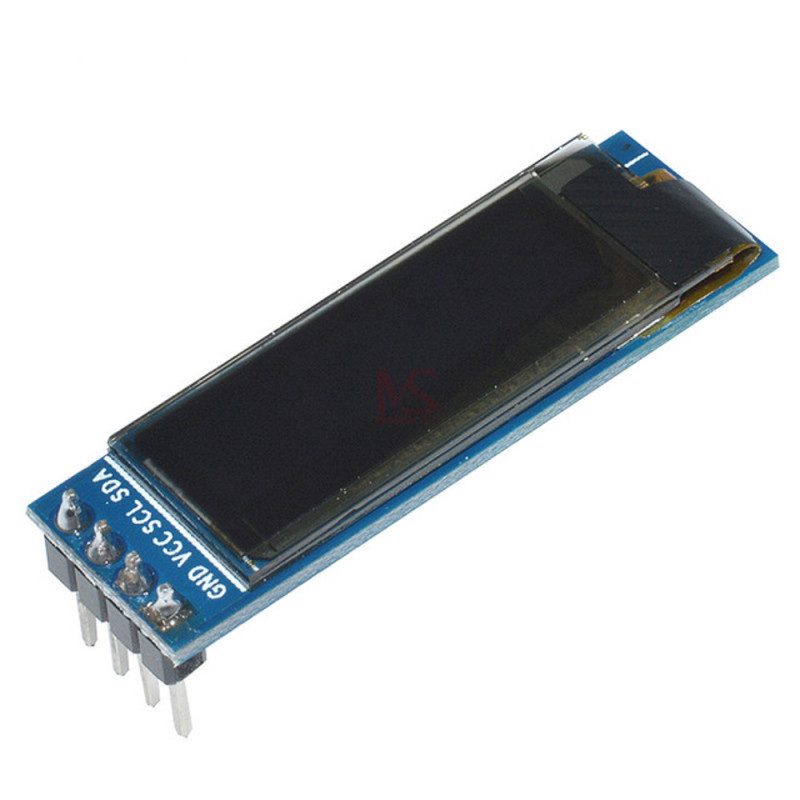
This 0.91 inch (2.32 cm) OLED display module offers 128 x 32 pixel resolution with much less thickness than an LCD and good brightness. It works without a backlight because the organic material produces its own light (electroluminescence), and it gives blue text on a black background with a very wide viewing angle.
It connects by I2C and uses the SSD1306 driver, which is supported by many libraries for Arduino, ESP boards and Raspberry Pi.
The module works from 3.3 to 5 V and operates from -30 to 70 C. The pins are GND, VCC, SCL (clock) and SDA (data). Its power requirement is low, which makes it good for battery-powered devices.
Wire the four pins, install an SSD1306 library, run an I2C scanner to find the address and open the example that draws text. At 128 x 32, the display holds about four lines of small text, so plan screens with short messages or simple icons.
Makers who want a small status display for sensors, wearables, badges and compact prototypes.
OLED pixels can burn in if the same image stays on for years, so use a screen saver or dim the display when idle. Keep wires short, use pull-up resistors if your board does not have them and check the I2C address (often 0x3C) before you run a sketch. The small size is great for status readouts, not for long paragraphs. Wrap the display in a small window in your enclosure and keep the module away from heat sources, since OLEDs age faster when they run hot.
128 x 32 pixels.
An SSD1306.
3.3 to 5 V.
No, the OLED is self-illuminating.
Blue on a black background.
| Brand | Generic |
|---|---|
| Display Interface | I2C |
| Display Resolution | 128x32 |
| Driver IC | SSD1306 |
| Operating Voltage | 3.3-5V |
| Selling unit | PCS |